Sandra LeBlanc
Five Days at MemorialSandra LeBlanc is a paramedic and emergency-medical-technology instructor whose efforts during Hurricane Katrina connected the stranded patients at Memorial Medical Center with volunteer boat crews outside the flooded city. With her husband, Mark, she helped locate a route to the hospital and bring airboats to it; when his mother, Vera, remained among the patients waiting for evacuation, Sandra helped carry her to a boat. Her actions unfolded amid fragmented rescue plans, scarce transport, and hospital evacuation priorities that left families to improvise where official systems had failed.
Background and the Search for a Way In
Sandra coordinated the Emergency Medical Technology program at Elaine P. Nunez Community College in nearby Chalmette. She had once administered state EMT examinations, a connection to public emergency services that became useful after the flooding, although she was no longer under contract with the state. She and Mark had evacuated from New Orleans and taken shelter with a relative in northern Louisiana. When news came that the city had flooded, they set out to reach his mother, Vera, a LifeCare patient at Memorial, and her sitter.
Their first stop was the state Bureau of Emergency Medical Services in Baton Rouge, where they sought volunteer identification badges. The request that she provide her next of kin unsettled Sandra: the detail made the uncertainty of the rescue effort suddenly personal. The bureau had run out of badges, and she had left her credentials behind before the storm. Concerned about checkpoints, the couple drove to a fire station about forty miles from New Orleans, hoping to join rescue crews. They waited through the day as firefighters waited for assignments. When several firefighters and their chief finally decided to drive toward a triage center west of the city, Sandra and Mark went with them.
Triage at the Interchange
At the interchange near Causeway Boulevard, the scale of the emergency was visible in the thousands of people gathered among debris and toppled light poles, an area also being used for helicopter landings. The search-and-rescue base enabled aircraft to ferry people in and out, but officials had not supplied the buses and drivers needed to move many arrivals onward. Sandra found former EMT students and joined them in sorting patients. She examined injured and ill people, including people with diabetes and missing limbs, and directed some toward ambulances bound for Baton Rouge.
The needs exceeded what the improvised teams could provide. People who had spent the night on rooftops sought shelter, food, and water. Sandra turned away a request for a bottle of water for someone’s mother because the medical teams had hidden their own limited supplies, fearing that they would be overwhelmed. She understood the decision as a harsh constraint, not a solution: sharing what little water they had could leave the teams without supplies for patients. The scene made the gap between rescue and care plain. People had reached a gathering point, but many still lacked the basic resources needed to get through the emergency.
Sandra also tried to find out whether anyone was organizing the evacuation of hospitals. Officials had called for boat owners to bring vessels to a suburban Sam’s Club, and Jefferson Parish president Aaron Broussard had publicly appealed for boats to rescue deputies. Hospitals could also be evacuated by water, but that evening Sandra saw boats still sitting on trailers along the interstate. Meanwhile, an ambulance bureau volunteer sent toward New Orleans to coordinate boats had failed to meet them; he reported that the boats had been stopped because of darkness and reports of snipers. When Vera’s sitter called in the middle of the night, Sandra found the volunteer and asked him to radio the command center. Her plea, recorded in the state EMS logs, described the nurses’ growing panic at Memorial. She was told the hospital had become a lower priority and that she should try to help with the boats at sunrise.
Bringing Boats to Memorial
At the Sam’s Club lot the next morning, Sandra and Mark met two airboat pilots looking for directions to hospitals. They told the pilots about Vera and the conditions described by her sitter. When volunteers were asked to scout routes to a list of hospitals that did not include Memorial, the LeBlancs learned that Memorial was being prioritized last. Mark knew the hospital and the surrounding streets well: he had been born there when it was called Baptist and his family had long received care there. The pilots agreed to go if the couple could guide them.
The group explored a route to the flood zone and found water on Jefferson Highway, near Ochsner Medical Center and the Orleans Parish line. Sandra and Mark explained that the highway led toward Memorial, continuing as Claiborne Avenue. The pilots launched their boats there. As they crossed the flooded streets, people in the water gestured for help, but the LeBlancs could only direct them toward dry land while continuing to the hospital. Two small aluminum boats joined the trip.
Mark went up seven flights of stairs to the LifeCare unit, where he found Vera in a hot, still ward, lying on a wet bed and asking for water. He and Sandra comforted her, then went to find out what was happening. Diane Robichaux, a senior LifeCare leader, had little information. The LeBlancs explained that they could bring more airboats and identified a place to drop patients, but Sandra emphasized that ambulances would be needed there to transport them onward. Robichaux could not contact her corporate office to request them, so the LeBlancs offered to make calls themselves. The attempt stalled over the need for an exact address for the boat landing. Robichaux could not provide one; as colleagues searched for a usable address or nearby cross street, the call with the ambulance company dropped.
Vera’s Evacuation
Sandra spent hours helping load the boats as hospital visitors and staff left. By late afternoon, she found Mark with Vera in a second-floor lobby. Although the couple had been told Vera would leave by helicopter, she had not been evacuated. Helicopters had arrived only rarely, and ambulances had not reached the boat drop-off. Vera’s gown carried family names and phone numbers the couple had written on it in preparation for the promised flight. She was among patients with DNR orders, but her instruction dated from more than a decade earlier and was meant to prevent resuscitation if her heart stopped; she was still alive and waiting.
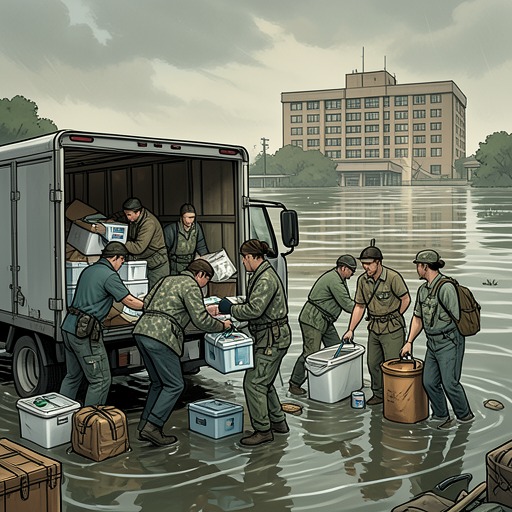
The pilots were running low on fuel, and reports that rescuers were being shot at made them unwilling to return the next day, despite the people still inside. With no clear destination for Vera, the LeBlancs decided to take her down to one of the boats. When they lifted her cot, it bent in the middle, and they had to adjust their hold. Several doctors objected to taking her. Sandra insisted that they either help or move aside. With two volunteers assisting, the couple carried Vera down to the ambulance ramp and lifted her onto a boat. Vera spoke excitedly about being on board and was fitted with earmuffs. Before leaving, Sandra also helped a hospital security guard who had worked alongside her on the ramp get onto the boat.
Character and Significance
Sandra’s work shifts between assessing strangers at the interchange and acting for one patient she knows personally. At the triage point, she had to limit assistance because supplies were scarce; at Memorial, she searched for information, tried to secure ambulances, and helped organize a route by water. Neither setting offered a complete rescue system. People had to be sorted without enough transport, and even a successful boat evacuation depended on a further handoff to ambulances that never materialized in time for many patients.
Vera’s removal also brought Sandra into direct conflict with the hospital’s evacuation order as it operated in practice: patients considered less urgent, including those with DNR orders, waited while staff and family members left. The evidence does not make Sandra a clinician deciding Vera’s treatment or establish that she controlled the broader evacuation. It shows something narrower and concrete: she helped challenge the delay surrounding one living patient, gathered volunteers and practical knowledge into a rescue effort, and stayed on the ramp long enough to help another worker leave. Her story gives individual shape to the broader failures of transport and coordination that left patients dependent on improvised aid.